ATLAS System Stats Bridge
The HWiNFO Bridge's sibling: streams whole-PC health - CPU, RAM, GPU, disk, network - into ATLAS, using the same pipeline, for the readings HWiNFO doesn't cover on its own.
The problem it solves
HWiNFO is deep on hardware sensors but doesn't see the OS layer - per-process load, disk
queue depth, network throughput as the OS reports it, swap usage. This bridge reads that
layer directly via psutil (CPU/RAM/disk/network) and pynvml (NVIDIA
GPU), and streams it through the exact same ATLAS Stream API and Kafka broker the HWiNFO
Bridge uses. The two are deliberately kept as siblings rather than merged: same ports, same
Docker stack, same web-UI shape, so switching between "what's the hardware doing" and "what's
the OS doing" costs nothing extra to learn.
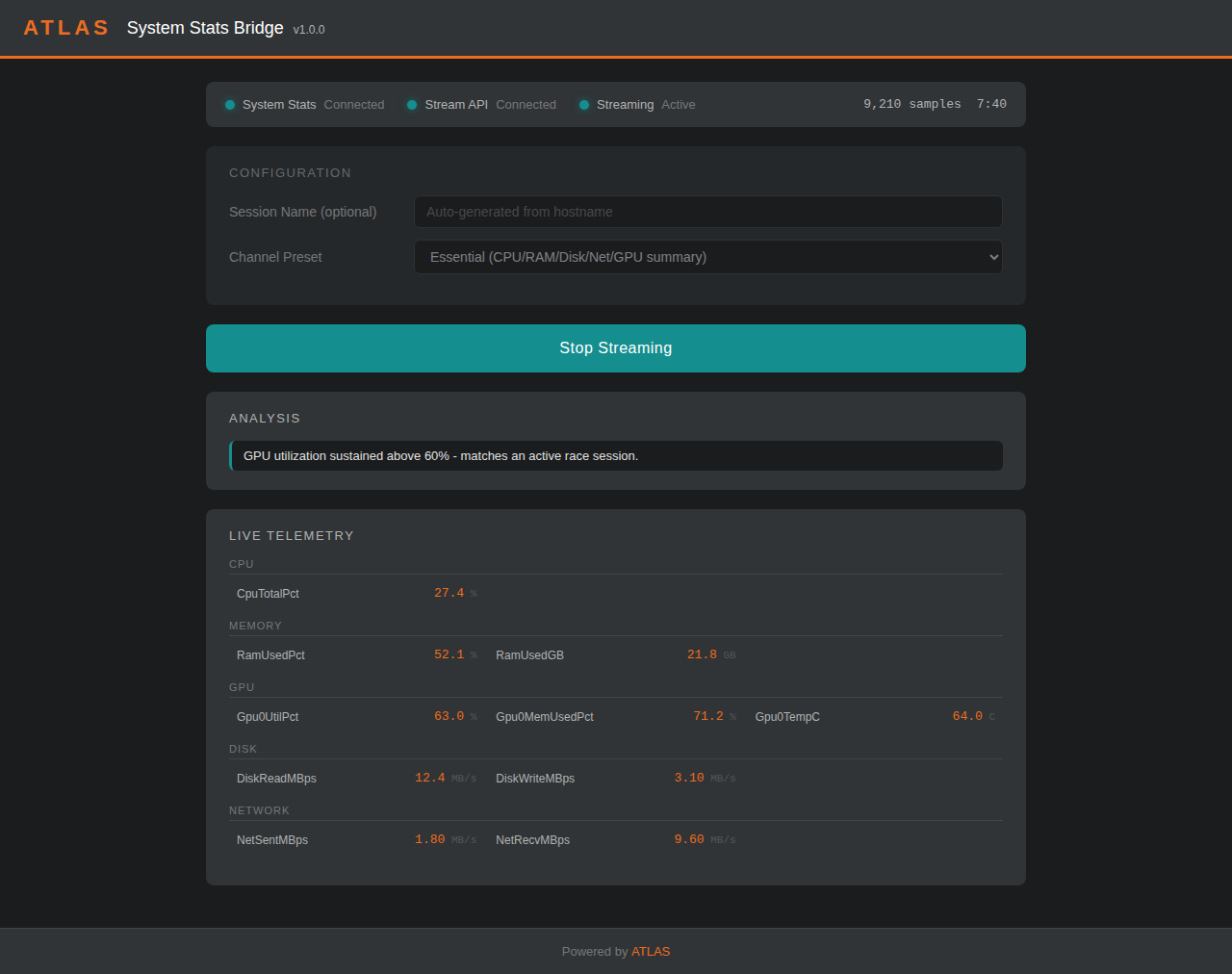
Same UI shape as the HWiNFO Bridge, streaming psutil/pynvml readings instead of HWiNFO's shared memory.
What's involved
Essential, CPU, Memory, Disk, Network, GPU, or Full - each preset is a named subset of a
fixed channel catalogue (unlike the HWiNFO Bridge, whose channels are discovered live),
since psutil/pynvml readings are the same shape on every machine.
CPU core count and GPU count are detected at startup, so the channel catalogue - and the "full" preset - scales automatically to however many cores and NVIDIA GPUs the host actually has.
Disk and network throughput and IOPS are derived from the difference between consecutive samples, so the very first sample after starting a session reports no data for those channels - a deliberate, documented tradeoff rather than a bug.
If the Stream API connection drops mid-session, the bridge reconnects on its own rather than requiring the driver to notice and restart it mid-race.
Standalone infrastructure, shared design
Same Docker stack as the HWiNFO Bridge - Kafka, the ATLAS Stream API, and a Key Generator service - with the bridge itself running natively on Windows. Only one of the sibling bridges can run at a time, since they share the same default ports; which one's active depends on whether the session needs hardware-sensor depth or OS-level system health.